
OEM vs Aftermarket Tesla Model 3 Hubcaps: What Are You Paying For?
When shopping for Tesla Model 3 hubcaps, it is easy to notice the price difference between factory OEM covers and aftermarket wheel covers.
OEM products offer familiar factory styling and predictable fitment. Aftermarket covers offer more freedom in design, protection, and personalization.
So what are you actually paying for?
The main difference in the OEM vs aftermarket Tesla Model 3 hubcaps comparison comes down to fitment, aerodynamic performance, durability, protection, style, and cost.
For Tesla owners, the right choice depends on whether you want to preserve the factory look or make your Model 3 feel more personal.
OEM vs Aftermarket Model 3 Hubcaps: Quick Comparison
|
Feature |
OEM Covers |
Aftermarket Covers |
|---|---|---|
|
Fitment |
Factory specifications |
Varies by design |
|
Appearance |
Original Tesla style |
|
|
Aerodynamics |
Factory engineered |
Depends on design |
|
Rim protection |
Standard |
Full-coverage options may offer more |
|
Installation |
Straightforward |
Varies |
|
Price |
Often higher |
Wide price range |
|
Personalization |
Limited |
Much greater |
Neither option is automatically better. The important question is what you value for your car.
What Are OEM Tesla Model 3 Wheel Covers?
OEM stands for Original Equipment Manufacturer.
Stock OEM covers are produced by Tesla or approved manufacturers to match factory specifications.
That means they are engineered around the original wheels, attachment points, lug nuts, dimensions, and overall Tesla design language.
For owners who prefer a factory appearance, OEM is the simple choice.
Installation is usually straightforward because the cover is designed for a specific Tesla model. Align the cover correctly, press it into place, and confirm that every attachment point is secure.
You are largely paying for consistency.
What Does the OEM Price Include?
OEM wheel covers are designed to match Tesla's original styling and aerodynamic goals.
At high speeds, exposed wheels create turbulence and aerodynamic drag. Aero-style covers help smooth the flow of air around the wheel, reducing resistance.
Under favorable driving conditions, Tesla wheel covers can potentially improve range by around 3% to 5%.
Actual efficiency depends on factors such as:
- speed
- tires
- temperature
- wind
- vehicle configuration
- driving conditions
So a 3% to 5% improvement should not be treated as guaranteed.
Still, if maximizing efficiency matters to you, an aerodynamic wheel design can make a difference.
OEM covers also maintain the clean, minimal appearance many owners associate with Tesla.
The trade-off is limited choice.
Why Choose Aftermarket Tesla Hubcaps?
Aftermarket wheel covers are made by third-party manufacturers.
Their biggest advantage is freedom.
Instead of staying with one factory design, Tesla owners can choose from different:
- colors
- spoke patterns
- performance styles
- aerodynamic shapes
- full-coverage designs
- finishes
- custom details
A well-designed aftermarket set can dramatically change the appearance of a Model 3 without replacing all four wheels.
Your original rims stay underneath.
That can make aftermarket covers a useful middle ground between keeping the factory setup and purchasing an entirely new wheel set.
Aftermarket Quality Can Vary
This is where buyers need to look beyond price.
Aftermarket quality varies significantly.
Some covers use thin, relatively fragile plastic, while higher-quality options may use durable ABS plastic or stronger composite materials.
A poor design can be more prone to:
- cracking
- vibration
- unusual noise
- loose fitment
- scratches
- premature wear
Better-engineered covers may include foam or rubber contact points to reduce vibration and help protect the factory wheel.
Before making a choice, look at material quality, attachment design, fitment information, weight, and durability—not just the product picture.
Can Aftermarket Covers Improve Aerodynamics?
Yes, if the design is properly engineered.
Some aftermarket wheel covers use a more closed wheel face to reduce drag around the wheels.
Under suitable conditions, aerodynamic aftermarket covers can also contribute to a 3% to 5% improvement in range.
However, not every aftermarket design prioritizes aerodynamics.
Some are built primarily for aesthetics.
If efficiency matters, choose a cover that balances visual style with an aerodynamic shape rather than assuming every aftermarket product performs the same way.
Which Offers Better Curb Rash Protection?
Some full-coverage aftermarket designs can offer more protection around the outer rim than standard factory covers.
A cover that extends closer to the rim edge can help protect against:
- curb rash
- light scratches
- minor parking contact
- road debris
- cosmetic wheel damage
No wheel cover can prevent every impact.
A hard hit against a curb can still damage the cover, wheel, or tire.
But for everyday parking, extra outer-rim coverage can give Tesla owners more peace of mind.
OEM vs Aftermarket: Style Is the Biggest Difference
OEM focuses on consistency.
Aftermarket focuses on personality.
The factory look is clean and recognizable, but many Model 3 owners eventually want something different.
Aftermarket covers can make the same vehicle look more sporty, aggressive, sleek, or personal without changing the wheels underneath.
That is also where HALOBLK takes the aftermarket idea further.
HALOBLK Custom Number: More Than a Different Wheel Style
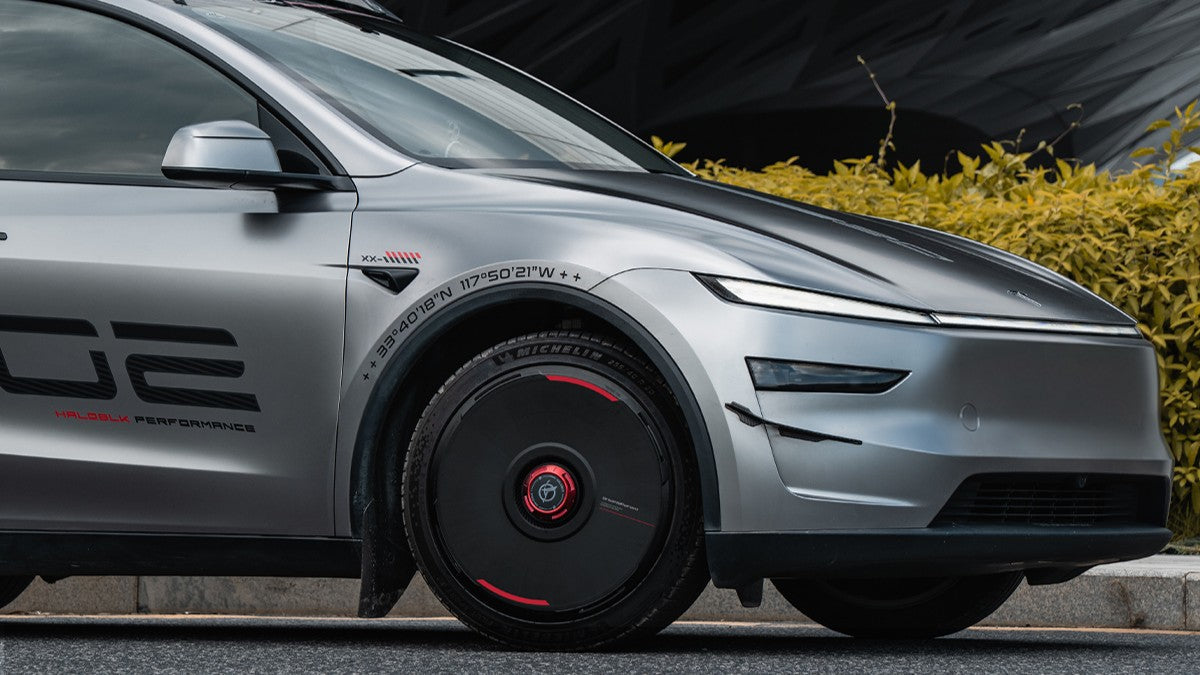
HALOBLK Custom Number HALODISC 2 is designed around personalization rather than simply offering another wheel-cover pattern.
The concept is Made Just for You.
Instead of choosing only a finish or spoke design, you choose a number that means something to you.
It could be:
- a lucky number
- birth year
- racing number
- anniversary
- something only you understand
The idea is Your Number, Your Story.
Each Custom Number set is positioned as a personalized HALODISC made one by one in the USA and shipped from the USA.
Beyond customization, it keeps the practical advantages of a full wheel-cover design, including basic rim protection, aerodynamic consideration, and HALOBLK's center-lock security system.
That makes the extra cost easier to understand: you are not simply paying for a piece of plastic with a number on it. You are paying for a wheel design created specifically for your Tesla.
Which One Should You Choose?
Choose OEM covers if you want:
- factory styling
- predictable fitment
- straightforward installation
- proven compatibility
- minimal decision-making
Choose aftermarket covers if you want:
- more customization
- greater design freedom
- additional outer-rim coverage
- a more distinctive look
- different aerodynamic options
The cheapest aftermarket set is not automatically the best value, just as the most expensive OEM product is not automatically the best choice.
Look at what has actually been engineered into the product.
The Bottom Line
When comparing OEM vs aftermarket Tesla Model 3 hubcaps, OEM is mainly about factory consistency.
Aftermarket is about choice.
If you simply want to maintain the original Tesla appearance, OEM makes sense.
If you want your Model 3 to look different while adding protection and keeping the original wheels underneath, aftermarket wheel covers give you much more creative freedom.
And if choosing a style is not personal enough, HALOBLK Custom Number takes it one step further.
Your Tesla already has a model number. Why not give its wheels a number that actually means something to you?

Leave a comment
All comments are moderated before being published.
This site is protected by hCaptcha and the hCaptcha Privacy Policy and Terms of Service apply.